About the motif
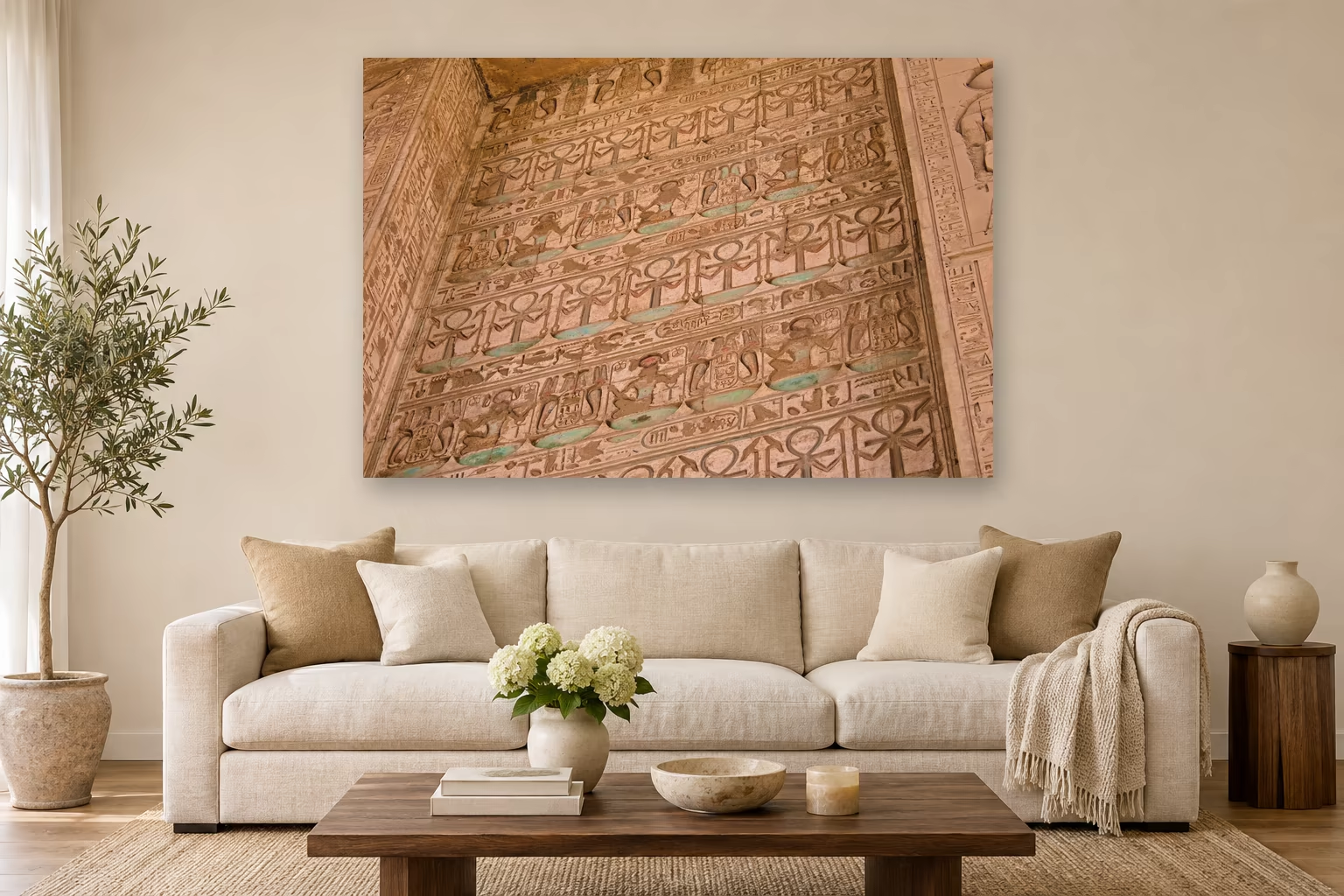
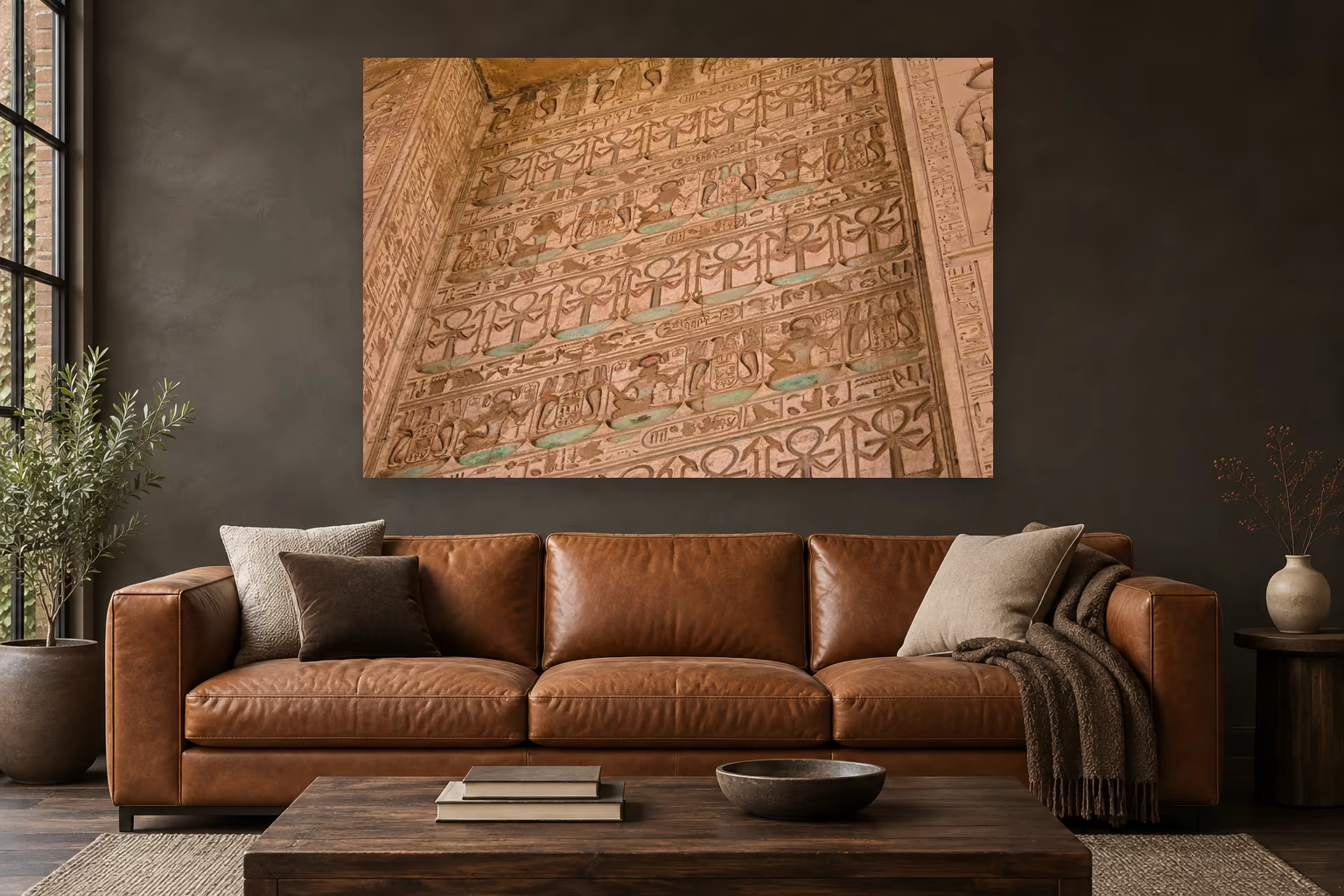
The wall fills the whole frame, divided into registers stacked horizontally. In the middle band the ankh signs stand in a dense row, each with the loop at the top, the crossbar and the foot. Between them lie cartouches with royal names and figures in profile, holding the signs or passing them to the figure opposite. The outlines are cut into the sandstone as a groove, so the figures lie in the stone. Turquoise, red and black paint has survived in the recesses, with joints between the blocks, cracks and chipped edges in between. No sky, no foreground, only stone and light from the upper left.
The ankh is the sign for life: a loop on a crossbar which, together with the upright, recalls a knot. In the reliefs the gods hold it in their hand and raise it to the king's nose so that he receives the breath of life. The rows are therefore not ornament but a promise repeated across the whole wall. In the temples of the Ptolemaic period the motif is densely staggered, often in several bands one above the other, until the surface consists almost entirely of signs.
The sandstone was worked with the chisel, the contours cut in as a groove, the inner surfaces levelled. Then came the paint: Egyptian blue for the loops, green for foliage, red ochre for skin and suns, black for contours and wigs. Because the pigments were applied with binders that hold up for a long time in the dry climate, remains survived precisely where wind, sand and hands could not reach. Today the artificial light inside the temple adds protection, because it carries no ultraviolet.
Walls like this are archives you can walk through: image, writing and colour carry the same statement in different languages. What is visible today is the remainder of a fully painted surface; that individual loops still look fresh is due to the depth of the carving and their position in half shade. Touch and climate wear the paint down, which is why distance and light matter more than any cleaning.
The image lives from its rhythm. The same signs, the same spacing, and in between the fine differences of weathering that give every spot its own face. The warm gold of the stone is broken by turquoise accents, the edges of the groove forming a dense play of lines. In a room such a surface carries calm and structure at once. This fine art print is particularly suited to studies and hallways, to reading corners and to living rooms with warm wood tones, where a dense, quiet surface does good.
Material and finish
Fine art canvas
The motif is printed in 12-colour pigment printing on cotton canvas and stretched on a 2 cm solid wood frame.
The textile surface gives the picture a warm feel. A mirrored edge carries the motif sideways; the front remains complete.
- Support material
- Cotton canvas, 260 g/m²
- 12-colour pigment inkjet
- Frame
- Wood, 2 cm
- Edge
- Mirrored motif
- Sizes
- 60 × 40 cm90 × 60 cm120 × 80 cm
- Scope of delivery
- Printed cotton canvas on a 2 cm wood frame, hanging set included. Without an additional picture frame or shadow gap frame. Screws and wall plugs are not included.
Aluminium Dibond
3 mm aluminium composite panel with polyethylene core, printed in UV-LED direct printing: the ink sits directly on the white coated surface.
For wall mounting you need a suitable hanging system and a fixing that matches your wall.
- Support material
- 3 mm aluminium composite panel
- UV-LED direct print
- Surface
- Matt
- Finish
- Frameless, right to the edge
- Sizes
- 60 × 40 cm90 × 60 cm120 × 80 cm
- Scope of delivery
- Printed panel without hanging set or wall mounting material
Fine art paper
Hahnemühle Museum Etching is an artist paper made of 100 % cotton, natural white and without optical brighteners. It is printed in pigment inkjet.
The paper can be framed as you wish.
- Support material
- Hahnemühle Museum Etching
- Weight
- 350 g/m²
- Composition
- 100 % cotton, acid and lignin free
- Pigment inkjet
- Sizes
- 60 × 40 cm90 × 60 cm120 × 80 cm
- Scope of delivery
- Paper print without frame