

About the motif
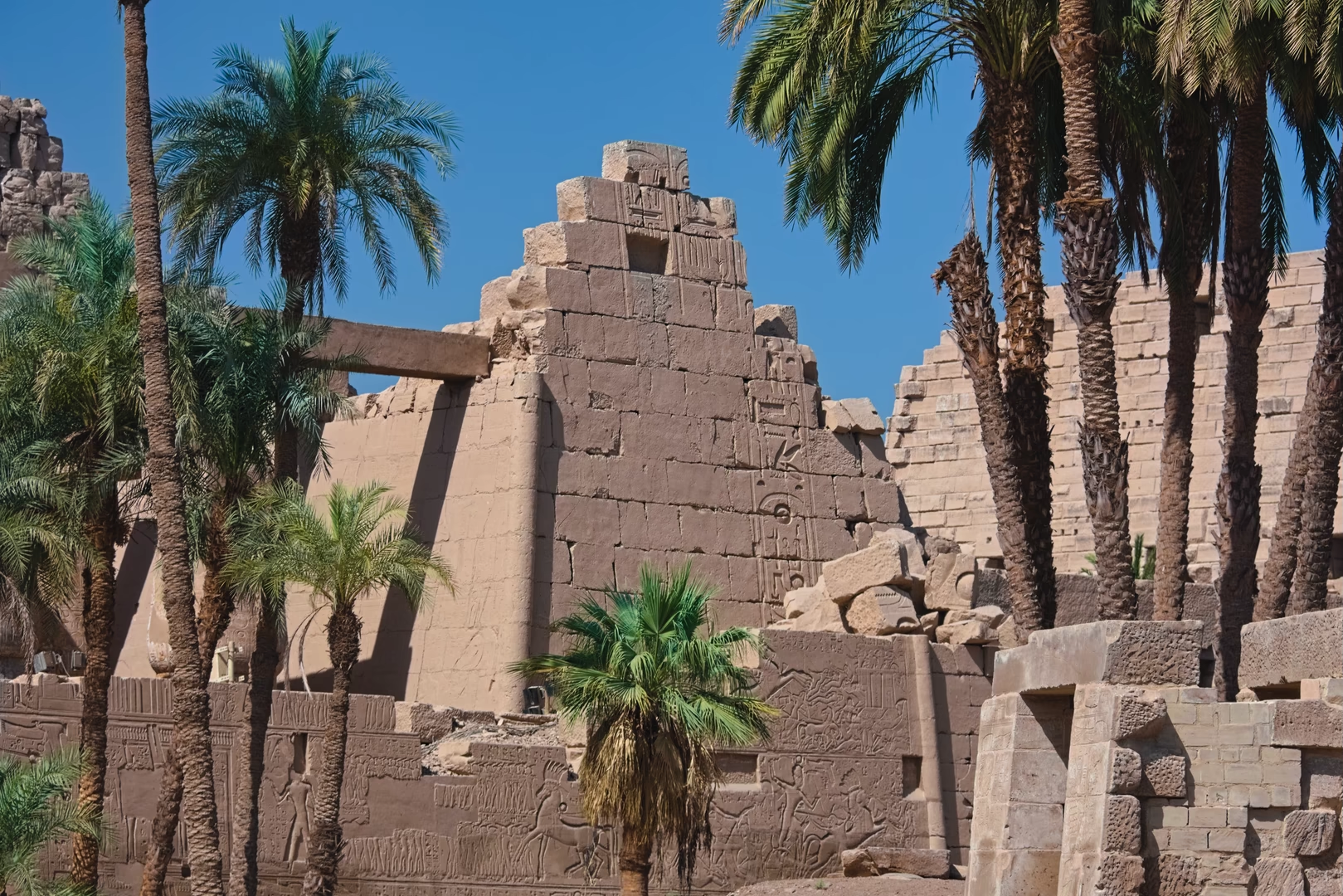
The view stands at the foot of a wall built of large sandstone blocks that breaks off in steps at the top. About nine courses survive, the highest consisting of a single block. Right of centre a vertical column of sunk hieroglyphs runs across several courses, beside it a cartouche, an oval ring around a royal name. On the left a horizontal beam leads up to the wall, on the right a lower wall remains behind palms. In the foreground a low wall with three relief registers runs across the full width, in front of it rubble and a stone block with a rectangular recess. Above everything stands a cloudless blue sky.
For two thousand years Karnak was the main temple of Amun-Re on the eastern bank of the Nile near Luxor. Every king built further, and every wall surface became a carrier of images and texts: processions, offerings, speeches of the gods. The cartouche, an oval ring around the name, records in whose reign a wall was built. Because the rulers built over one another and added their names, the building phases can still be read from the inscriptions.
The sandstone comes from the quarries at Gebel el-Silsila, some fifty kilometres south of Luxor, from where the blocks were brought up the Nile. The reliefs are carved in sunk technique, so the figures lie in the stone and cast shadows when the sun is low, which sharpens the outline. The surfaces are smoothed by wind, the edges chipped, sand sits in the joints. Salt from the ground and groundwater have split individual blocks and worn the signs away in many places beyond recognition.
For a long time the site served as a quarry, whole parts of the temple disappeared into the houses of the surrounding area. Since the nineteenth century Karnak has been excavated, cleaned, surveyed and secured systematically. What came to light stands in the open today: walls without roofs, reliefs without colour, palms growing out of the rubble between them.
The image lives from the collision of two textures: the large block surfaces, in which every joint is traced, and the fine grooves of the writing. The warm beige of the stone stands against the deep blue of the sky, with the green of the palm fronds in between. As a wall piece the photograph brings structure into a room without becoming restless. This fine art print is particularly suited to studies, to hallways and to living rooms with warm wood tones, where a calm surface of stone and light does good.
Material and finish
Fine art canvas
The motif is printed in 12-colour pigment printing on cotton canvas and stretched on a 2 cm solid wood frame.
The textile surface gives the picture a warm feel. A mirrored edge carries the motif sideways; the front remains complete.
- Support material
- Cotton canvas, 260 g/m²
- 12-colour pigment inkjet
- Frame
- Wood, 2 cm
- Edge
- Mirrored motif
- Sizes
- 60 × 40 cm90 × 60 cm120 × 80 cm
- Scope of delivery
- Printed cotton canvas on a 2 cm wood frame, hanging set included. Without an additional picture frame or shadow gap frame. Screws and wall plugs are not included.
Aluminium Dibond
3 mm aluminium composite panel with polyethylene core, printed in UV-LED direct printing: the ink sits directly on the white coated surface.
For wall mounting you need a suitable hanging system and a fixing that matches your wall.
- Support material
- 3 mm aluminium composite panel
- UV-LED direct print
- Surface
- Matt
- Finish
- Frameless, right to the edge
- Sizes
- 60 × 40 cm90 × 60 cm120 × 80 cm
- Scope of delivery
- Printed panel without hanging set or wall mounting material
Fine art paper
Hahnemühle Museum Etching is an artist paper made of 100 % cotton, natural white and without optical brighteners. It is printed in pigment inkjet.
The paper can be framed as you wish.
- Support material
- Hahnemühle Museum Etching
- Weight
- 350 g/m²
- Composition
- 100 % cotton, acid and lignin free
- Pigment inkjet
- Sizes
- 60 × 40 cm90 × 60 cm120 × 80 cm
- Scope of delivery
- Paper print without frame