
About the motif
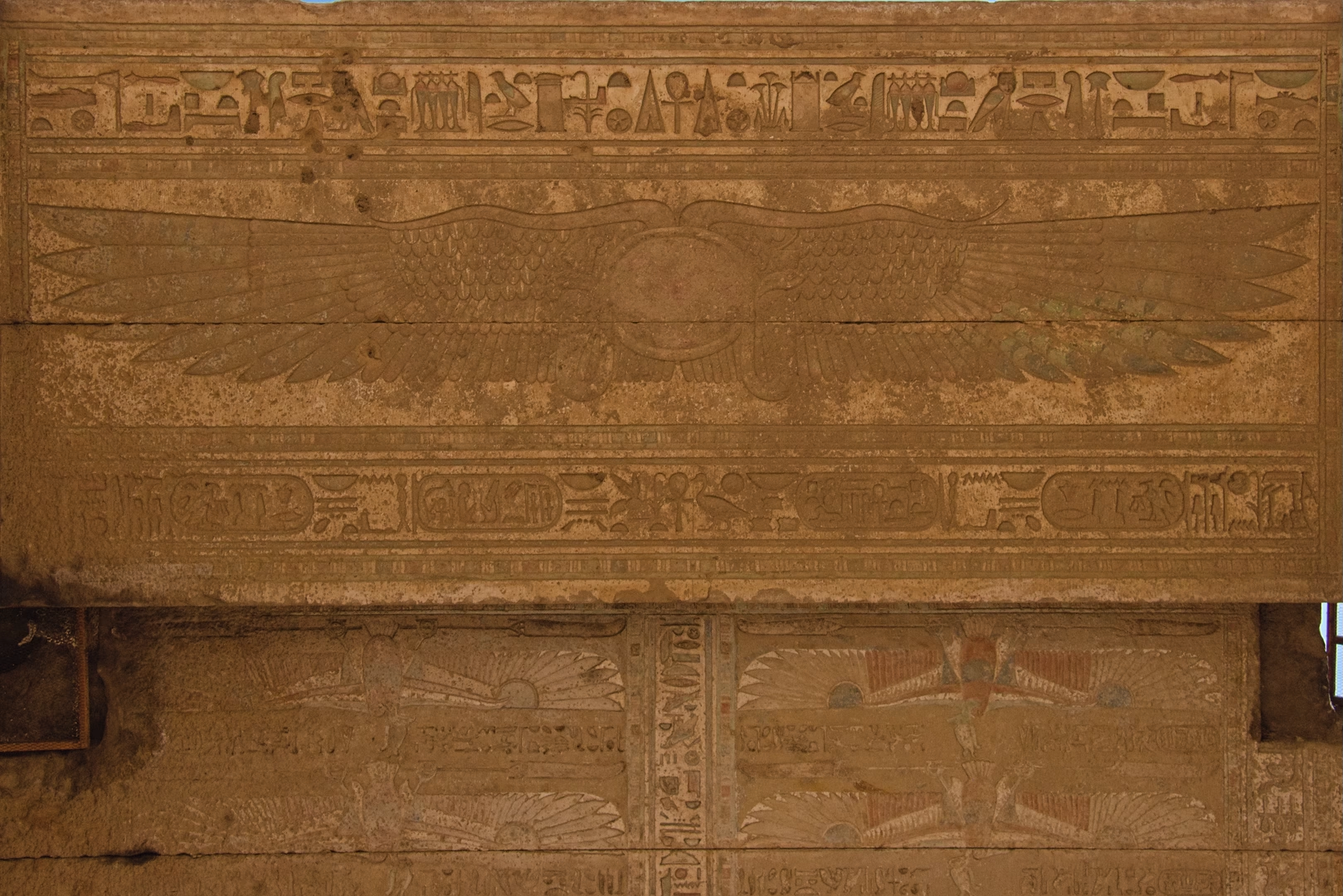
The relief fills the whole frame, there is no sky and no background, only stone. Across the top runs a broad band of sunk hieroglyphs with cartouches, beneath it the winged sun disk opens up, the centre a round disk, the wings stretched far to both sides, the feathers engraved in dense rows. Below the motif follows a second band of writing, and under that a vertical column divides the surface. To the left and right of it four smaller winged suns appear, the lower row cut off by the edge of the image. In the lower part traces of red and blue-green paint have survived.
The winged disk is among the oldest protective signs of Egypt. It was placed above doors, on architraves and on ceilings, often flanked at the wings by uraeus serpents, and was meant to ward off harm from what lay beneath it. In the temples of the Ptolemaic and Roman period the motif returns in dense succession, framed by cartouches naming the reigning ruler. Every wall was at once structure and carrier of text.
The sandstone was worked with the chisel, the figures lie sunk in the stone, their outlines cut in as a groove. Afterwards the surface was painted: red ochre for the sun, Egyptian blue and green for the feathers, black for the contours, yellow ochre for the ground. Because the paint was applied with binders that hold up astonishingly well in the dry climate, remains have survived in the recessed parts, where wind and sand could not reach.
Today the stone shows crusts, soot and salt efflorescence, the edges are chipped, individual signs barely legible. What remains is the structure: the drawing of the feathers, the order of the bands, the alternation of smooth surface and cut line. That is precisely where the effect of this detail lies.
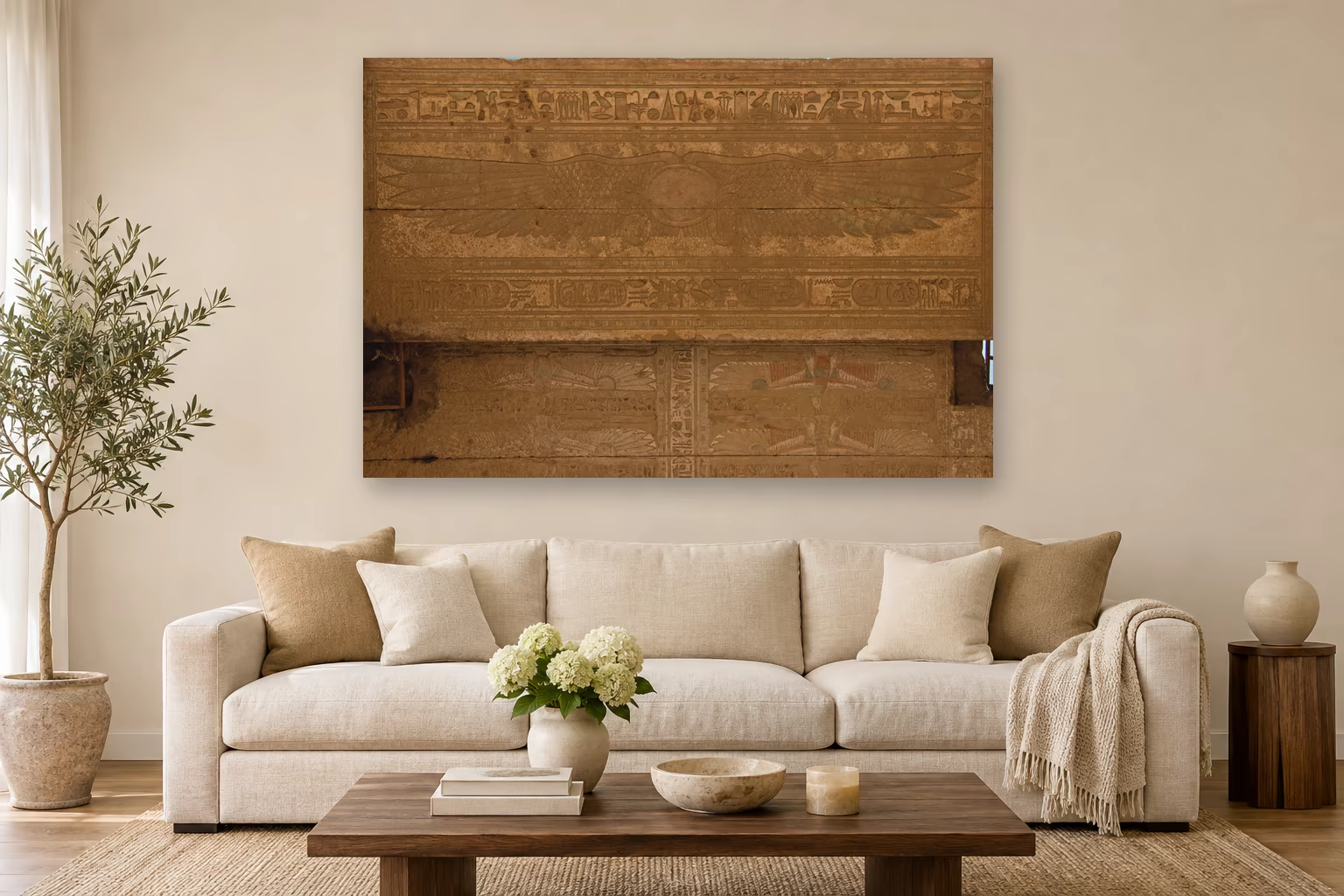
The image lives from its density. The patterns of feathers and signs are small and even, the warm ochre broken by red and blue-green accents. In a room such a surface reads as calm and detailed at once, it carries large formats and stays legible when small. This fine art print is particularly suited to studies, to hallways and to living rooms with warm wood tones, where a dense, quiet surface does good.
Material and finish
Fine art canvas
The motif is printed in 12-colour pigment printing on cotton canvas and stretched on a 2 cm solid wood frame.
The textile surface gives the picture a warm feel. A mirrored edge carries the motif sideways; the front remains complete.
- Support material
- Cotton canvas, 260 g/m²
- 12-colour pigment inkjet
- Frame
- Wood, 2 cm
- Edge
- Mirrored motif
- Sizes
- 60 × 40 cm90 × 60 cm120 × 80 cm
- Scope of delivery
- Printed cotton canvas on a 2 cm wood frame, hanging set included. Without an additional picture frame or shadow gap frame. Screws and wall plugs are not included.
Aluminium Dibond
3 mm aluminium composite panel with polyethylene core, printed in UV-LED direct printing: the ink sits directly on the white coated surface.
For wall mounting you need a suitable hanging system and a fixing that matches your wall.
- Support material
- 3 mm aluminium composite panel
- UV-LED direct print
- Surface
- Matt
- Finish
- Frameless, right to the edge
- Sizes
- 60 × 40 cm90 × 60 cm120 × 80 cm
- Scope of delivery
- Printed panel without hanging set or wall mounting material
Fine art paper
Hahnemühle Museum Etching is an artist paper made of 100 % cotton, natural white and without optical brighteners. It is printed in pigment inkjet.
The paper can be framed as you wish.
- Support material
- Hahnemühle Museum Etching
- Weight
- 350 g/m²
- Composition
- 100 % cotton, acid and lignin free
- Pigment inkjet
- Sizes
- 60 × 40 cm90 × 60 cm120 × 80 cm
- Scope of delivery
- Paper print without frame