About the motif
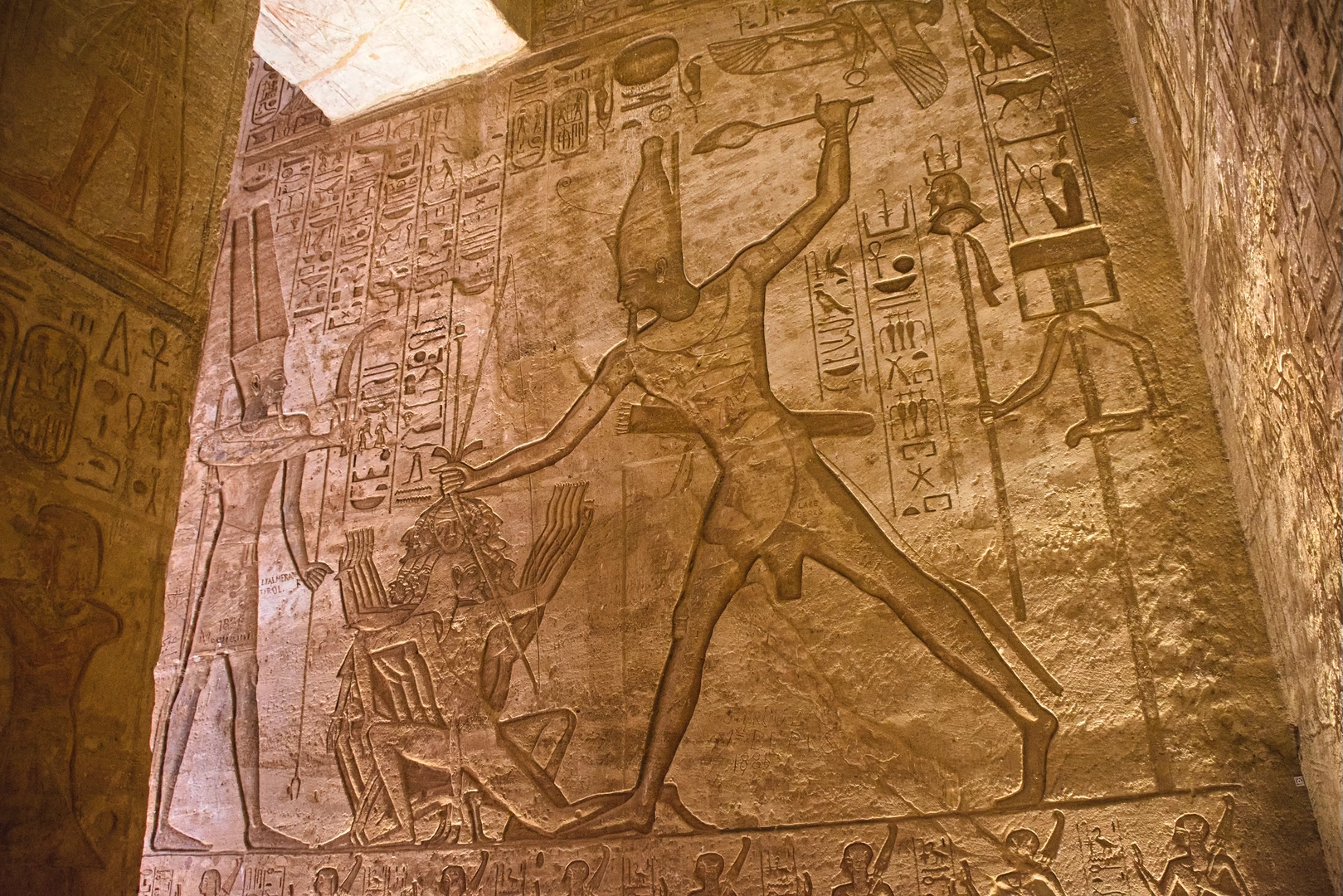
The wall fills almost the whole frame. On the left stands a darker side wall at an angle, then comes the large surface with the scene, and on the right it runs out into a narrow wall seen in perspective. Along the top run bands of inscription, in the upper left sits a bright field of light, at the bottom a ground line closes the scene and beneath it a second register of smaller figures begins. Between the figures stand columns of signs that fill almost every free space. The stone is warm ochre, and a grey tone sits in the hollows.
In the centre the king steps forward, left foot in front. He wears the tall crown, the royal beard and the short pleated kilt; the right hand is raised with the mace, the left grips an enemy by the hair. The enemy is much smaller and kneels, arms raised in defence. On the left stands a second figure with a staff, and captives crouch before it. On the right rises a standard with a small shrine, two figures with life signs inside. All of it is sunk relief: the outlines are cut into the stone and appear as shadow.
The sandstone is fine-grained and takes fine lines; cracks run across the surface, and at the edges the stone is washed out. The light comes from the upper left and lies at an angle across the wall, so the incised outlines step forward as dark lines while the surfaces between them stay bright. The colours sit close together: ochre, grey-brown, a warm red-brown in the shadows, and a bright glow at the upper left. At ISO 2800 and a sixtieth of a second the surface stays grainy, yet the signs can be read into the corners.
The king who holds an enemy by the hair and raises the mace is one of the oldest images of Egypt; on temple walls it repeats for two thousand years. It shows no campaign but the order the king establishes: the enemy stands for chaos, held off at the edge of the sanctuary. Ramses II had both temples of Abu Simbel cut into the sandstone above the Nile in the thirteenth century BC, the great one for the state gods, the small one for Hathor and Nefertari. His name is carried on the walls in hundreds of cartouches, and whoever reads the signs finds him again between every figure.
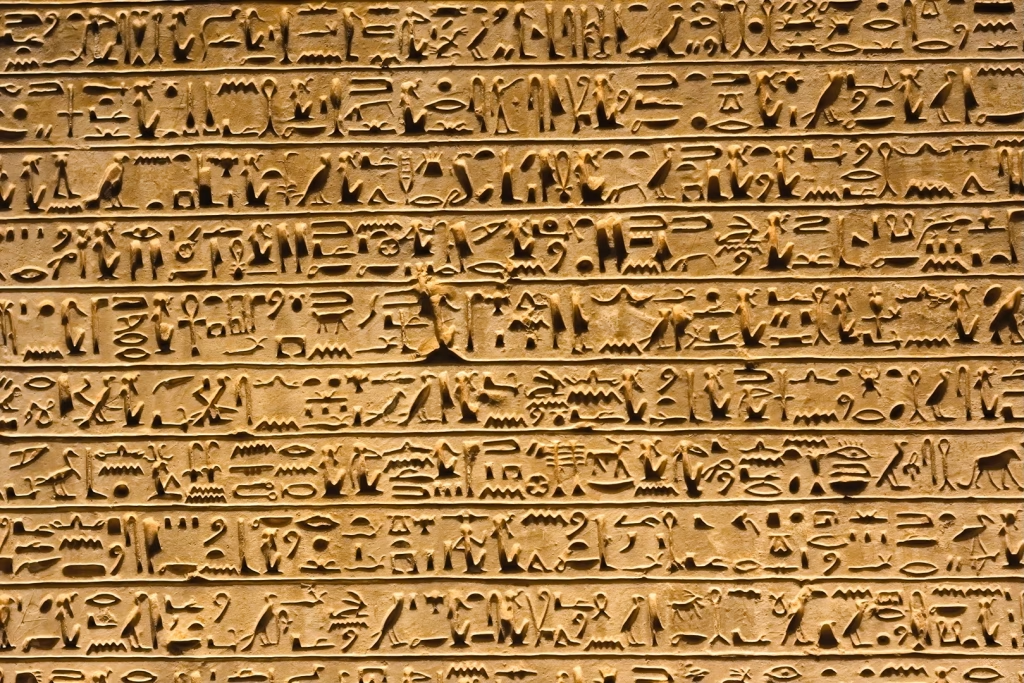
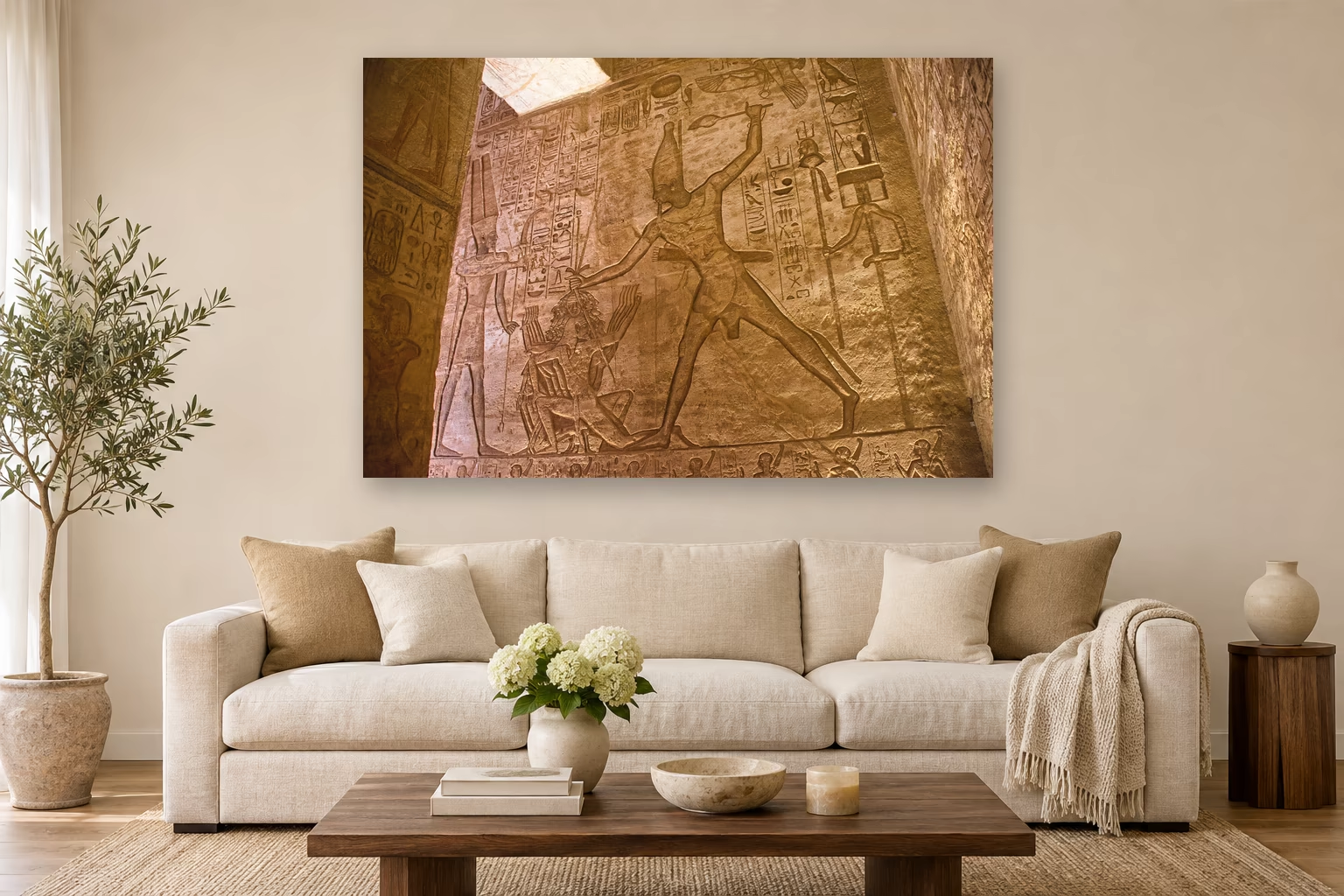
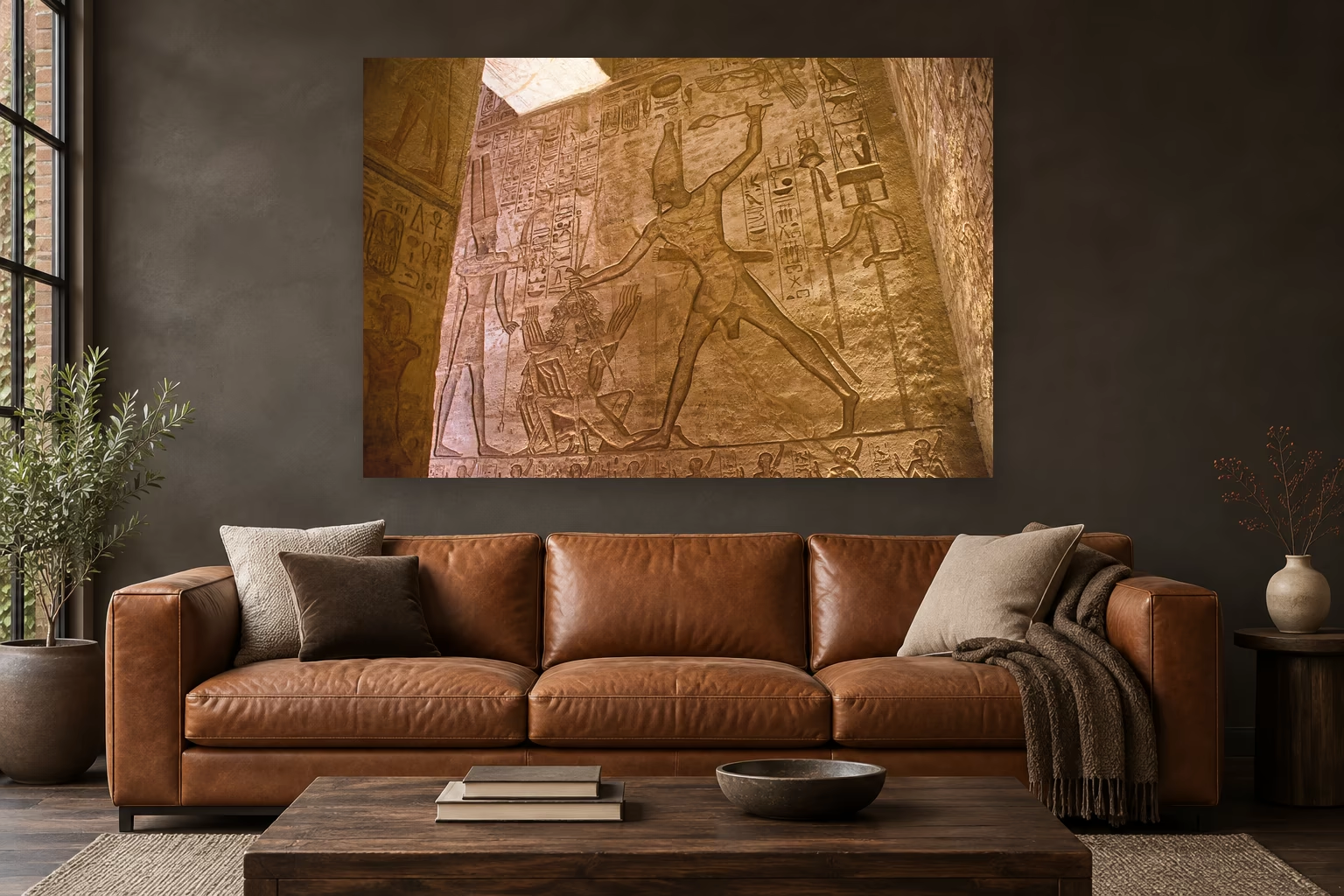
A picture of this kind lives from the size of the print. At 60 × 40 cm the scene is visible but the individual signs stay small; only at 90 × 60 cm do the cartouches and the cracks in the stone become readable, and at 120 × 80 cm the wall turns into a surface one reads like a script. Matt paper gives the ochre a calm tone and keeps the darks soft, aluminium Dibond lets the cut lines stand harder. Side light from the left suits it because it runs in the same direction as the light in the picture; direct light from the front flattens the relief.
Material and finish
Fine art canvas
The motif is printed in 12-colour pigment printing on cotton canvas and stretched on a 2 cm solid wood frame.
The textile surface gives the picture a warm feel. A mirrored edge carries the motif sideways; the front remains complete.
- Support material
- Cotton canvas, 260 g/m²
- 12-colour pigment inkjet
- Frame
- Wood, 2 cm
- Edge
- Mirrored motif
- Sizes
- 60 × 40 cm90 × 60 cm120 × 80 cm
- Scope of delivery
- Printed cotton canvas on a 2 cm wood frame, hanging set included. Without an additional picture frame or shadow gap frame. Screws and wall plugs are not included.
Aluminium Dibond
3 mm aluminium composite panel with polyethylene core, printed in UV-LED direct printing: the ink sits directly on the white coated surface.
For wall mounting you need a suitable hanging system and a fixing that matches your wall.
- Support material
- 3 mm aluminium composite panel
- UV-LED direct print
- Surface
- Matt
- Finish
- Frameless, right to the edge
- Sizes
- 60 × 40 cm90 × 60 cm120 × 80 cm
- Scope of delivery
- Printed panel without hanging set or wall mounting material
Fine art paper
Hahnemühle Museum Etching is an artist paper made of 100 % cotton, natural white and without optical brighteners. It is printed in pigment inkjet.
The paper can be framed as you wish.
- Support material
- Hahnemühle Museum Etching
- Weight
- 350 g/m²
- Composition
- 100 % cotton, acid and lignin free
- Pigment inkjet
- Sizes
- 60 × 40 cm90 × 60 cm120 × 80 cm
- Scope of delivery
- Paper print without frame