
About the motif
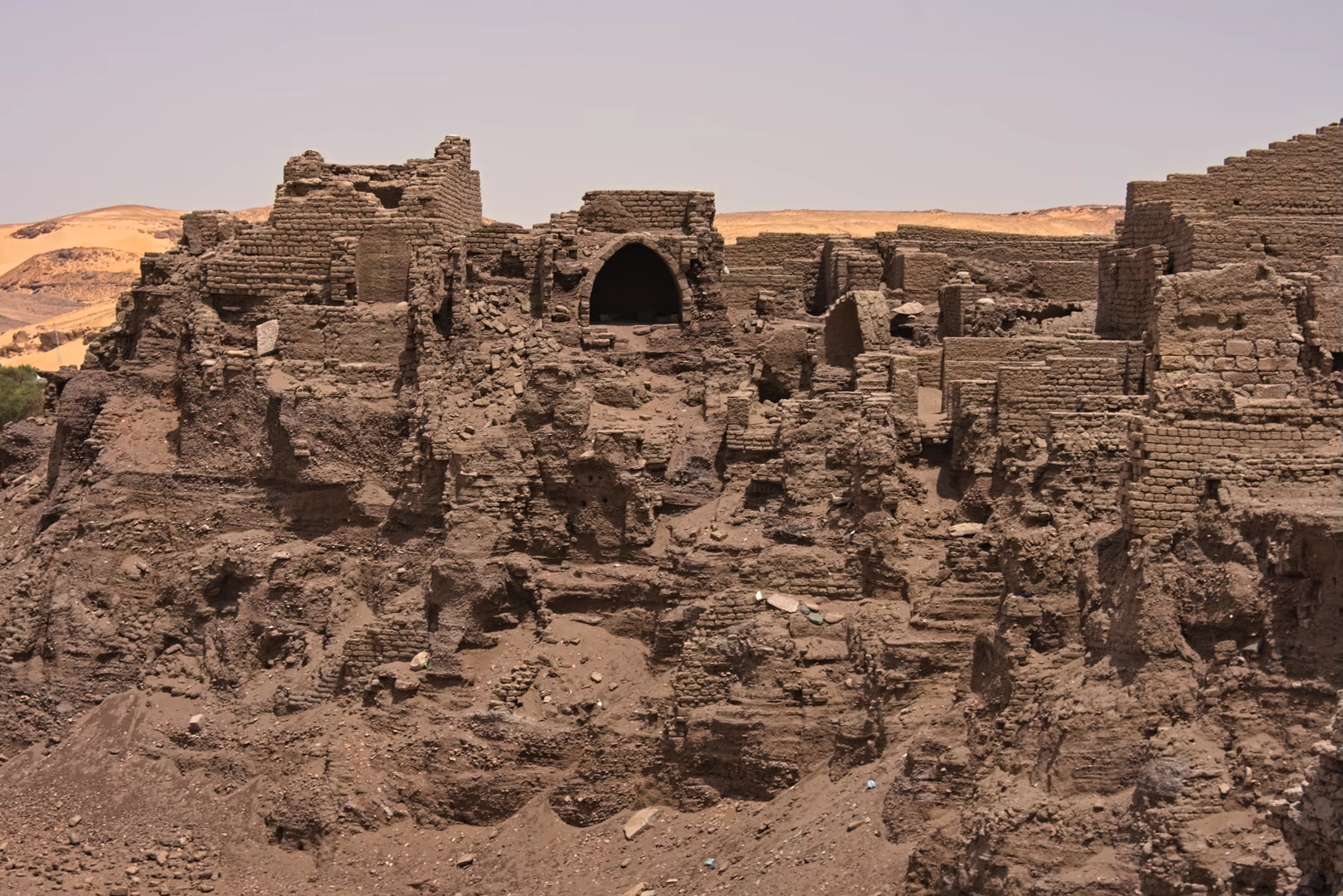
The sky is only a strip at the top edge, pale and hazy, with a low ridge of sand below it. Then the ruin fills the frame: walls of mud brick, packed close together, lanes between them whose ground is covered with rubble. In the middle sits a dark arch, almost black, and to its right a stepped wall leading upwards. The top edges of the walls are broken, and where they break the courses of the bricks show.
The walls are made of unfired mud, laid in courses, each about a hand high. Rectangular hollows sit in the surfaces, holes for beams, small niches, and at the corners the edges are worn so round that the walls look grown rather than built. Narrow courtyards and lanes lie between them, repeating in the picture as dark slits. At the foot lies loose earth, lumps of clay and stone, and sand has settled into every joint.
The light stands high and hard, the shadows are short and sharp, and every hole in the wall turns into a black patch. The colours are almost monochrome: ochre, beige, a warm grey, and between them the pale sky; only a few places are darker, where the clay stood damp or salt has bloomed out. At 52 mm the wall lines lie close behind one another, which makes the picture flat, and only the shadows give it depth. At ISO 500 and a five-hundredth of a second everything stays sharp down to the grains of sand.
The ruin lies on Elephantine, an island in the Nile at Aswan. The town there is one of the oldest settlements of Egypt; it lay on the border towards Nubia, and whoever travelled upstream passed it. On the island stood a temple of Khnum, the god who forms people on the potter's wheel, and a nilometer where the level of the river was measured. Because the island was small, the houses were built close together, and what stands today is above all this crowding of clay: foundation walls, doorways, niches. People have been digging here for decades.
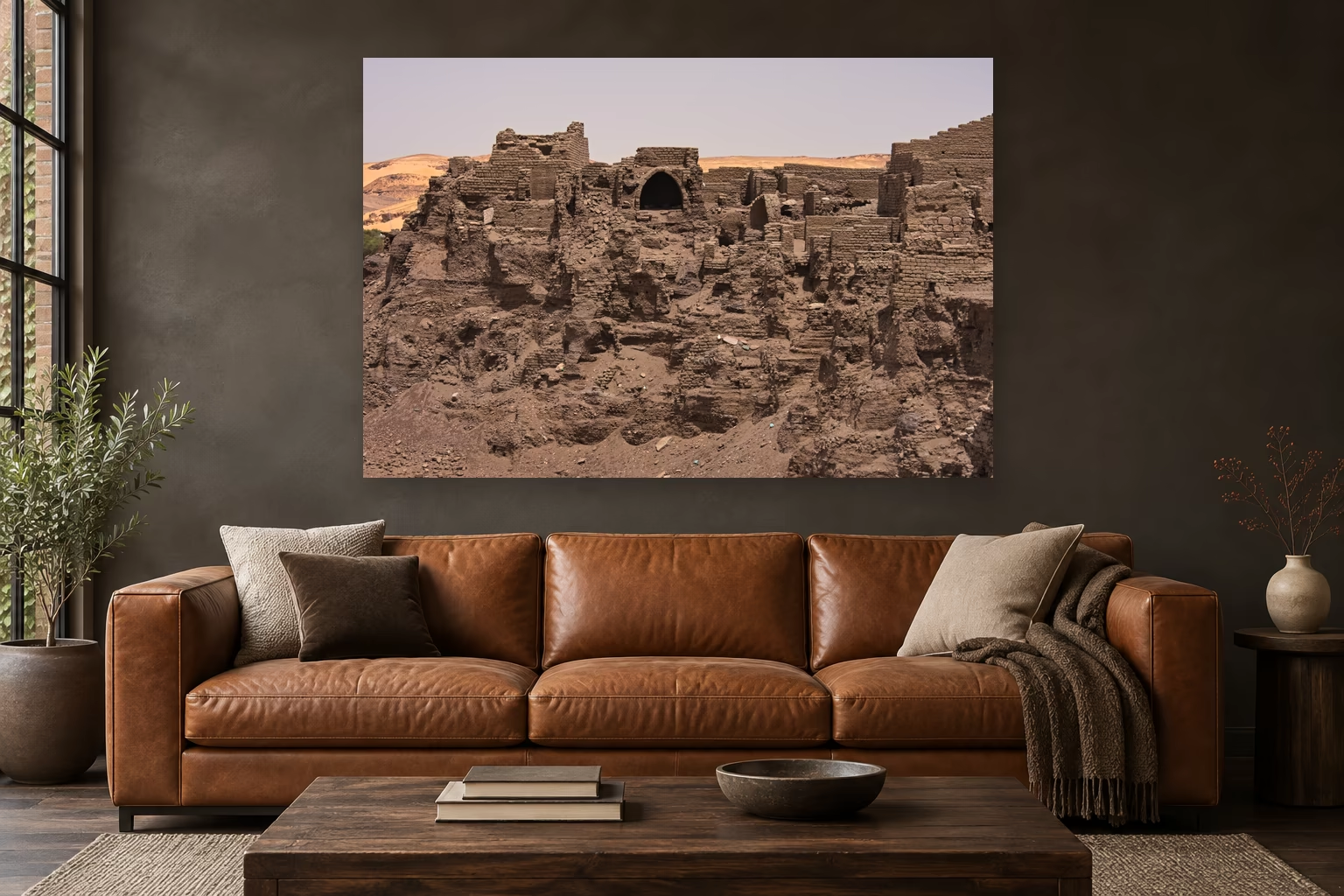
For print the picture is a surface: clay, sand and a strip of sky in which the arch sits as a dark point. Matt paper keeps the warm tones calm and the shadows open, aluminium Dibond gives the wall structure more relief and makes the shadows harder. At 60 × 40 cm the courses of the bricks can be read, at 90 × 60 cm the lanes step forward as depth, and at 120 × 80 cm the ruin works like a wall in the room. Side light suits it; direct light from the front takes the drawing out of the hollows.
Material and finish
Fine art canvas
The motif is printed in 12-colour pigment printing on cotton canvas and stretched on a 2 cm solid wood frame.
The textile surface gives the picture a warm feel. A mirrored edge carries the motif sideways; the front remains complete.
- Support material
- Cotton canvas, 260 g/m²
- 12-colour pigment inkjet
- Frame
- Wood, 2 cm
- Edge
- Mirrored motif
- Sizes
- 60 × 40 cm90 × 60 cm120 × 80 cm
- Scope of delivery
- Printed cotton canvas on a 2 cm wood frame, hanging set included. Without an additional picture frame or shadow gap frame. Screws and wall plugs are not included.
Aluminium Dibond
3 mm aluminium composite panel with polyethylene core, printed in UV-LED direct printing: the ink sits directly on the white coated surface.
For wall mounting you need a suitable hanging system and a fixing that matches your wall.
- Support material
- 3 mm aluminium composite panel
- UV-LED direct print
- Surface
- Matt
- Finish
- Frameless, right to the edge
- Sizes
- 60 × 40 cm90 × 60 cm120 × 80 cm
- Scope of delivery
- Printed panel without hanging set or wall mounting material
Fine art paper
Hahnemühle Museum Etching is an artist paper made of 100 % cotton, natural white and without optical brighteners. It is printed in pigment inkjet.
The paper can be framed as you wish.
- Support material
- Hahnemühle Museum Etching
- Weight
- 350 g/m²
- Composition
- 100 % cotton, acid and lignin free
- Pigment inkjet
- Sizes
- 60 × 40 cm90 × 60 cm120 × 80 cm
- Scope of delivery
- Paper print without frame