
About the motif
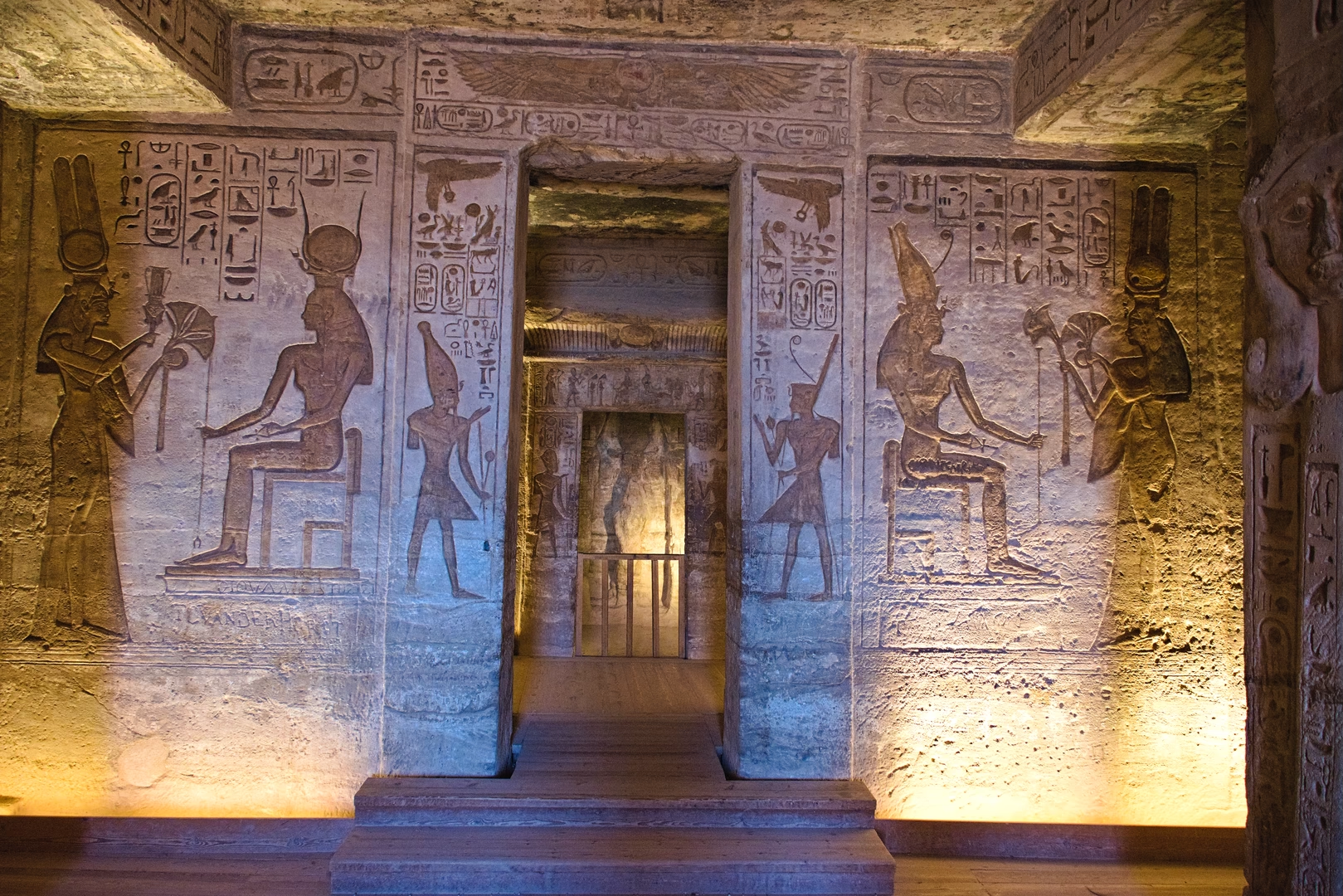
The picture is built almost symmetrically: the doorway in the centre, a relief wall to either side, the lintel above, the threshold with a shallow step in front. The doorway stands open, and behind it lies a second room whose opening is closed by a metal grille. The jambs are filled entirely with relief, small figures face each other, cartouches hang above them. Over the door runs a broad band of signs, further bands follow, until the ceiling gives way to dark rock.
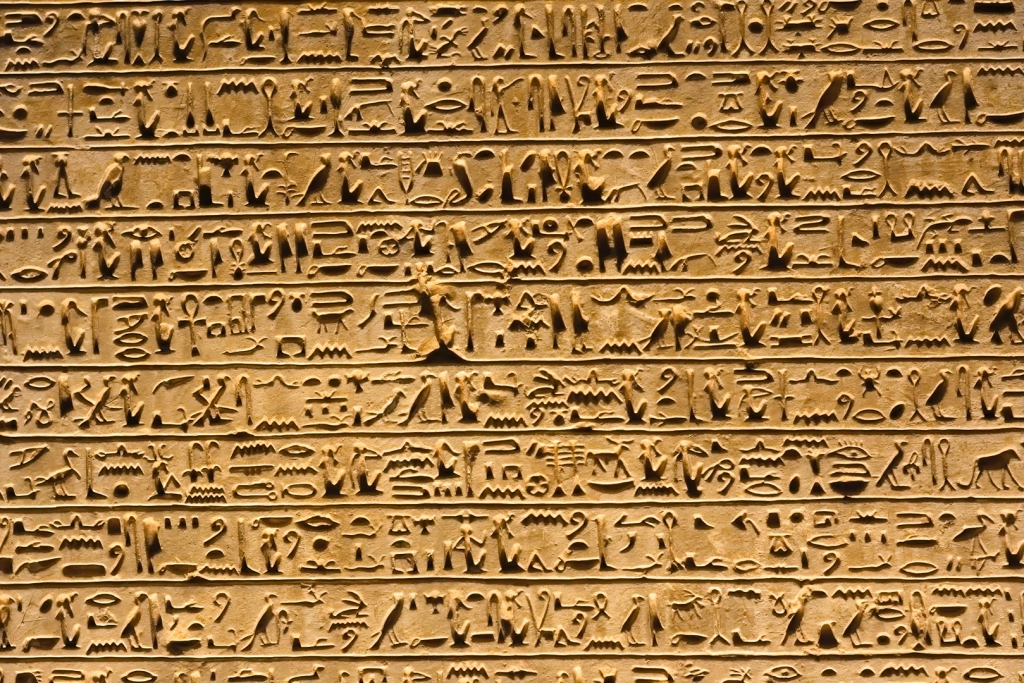
On the walls seated and standing figures alternate. On the block thrones sit gods with a disc above the head, before them stride kings with tall crown, staff and whisk, one leg forward, hands carrying an offering. Between the figures stand narrow columns of signs, and in the captions the king's name rings repeat. The outlines are cut into the stone and no paint has survived; at the edges of the blocks the profiles are chipped, the faces worn flat.
The light comes from below. Spots on the floor throw warm yellow onto the lower halves of the walls and let every hollow stand as shadow, while the upper courses stay in cool grey. Between them the doorway sits as a dark frame, with only a strip of light falling into the room behind. The sandstone is porous, full of small holes and cracks, worn smooth at the threshold by feet. At ISO 2200 and a sixtieth of a second the surface stays slightly grainy, and the signs are sharp into the corners.
A threshold is no small matter in an Egyptian temple. From room to room the floor rises, the ceiling sinks, the doorways grow lower, and whoever goes on has to bow the head: the building does not lead out into space but into narrowness, until the sanctuary stands at the end. Above the doorway the winged sun carries the temple outwards, and the cartouches name the king who built it. Ramses II had the temples of Abu Simbel cut into the rock, and when the reservoir came they were taken apart block by block and set up again higher.
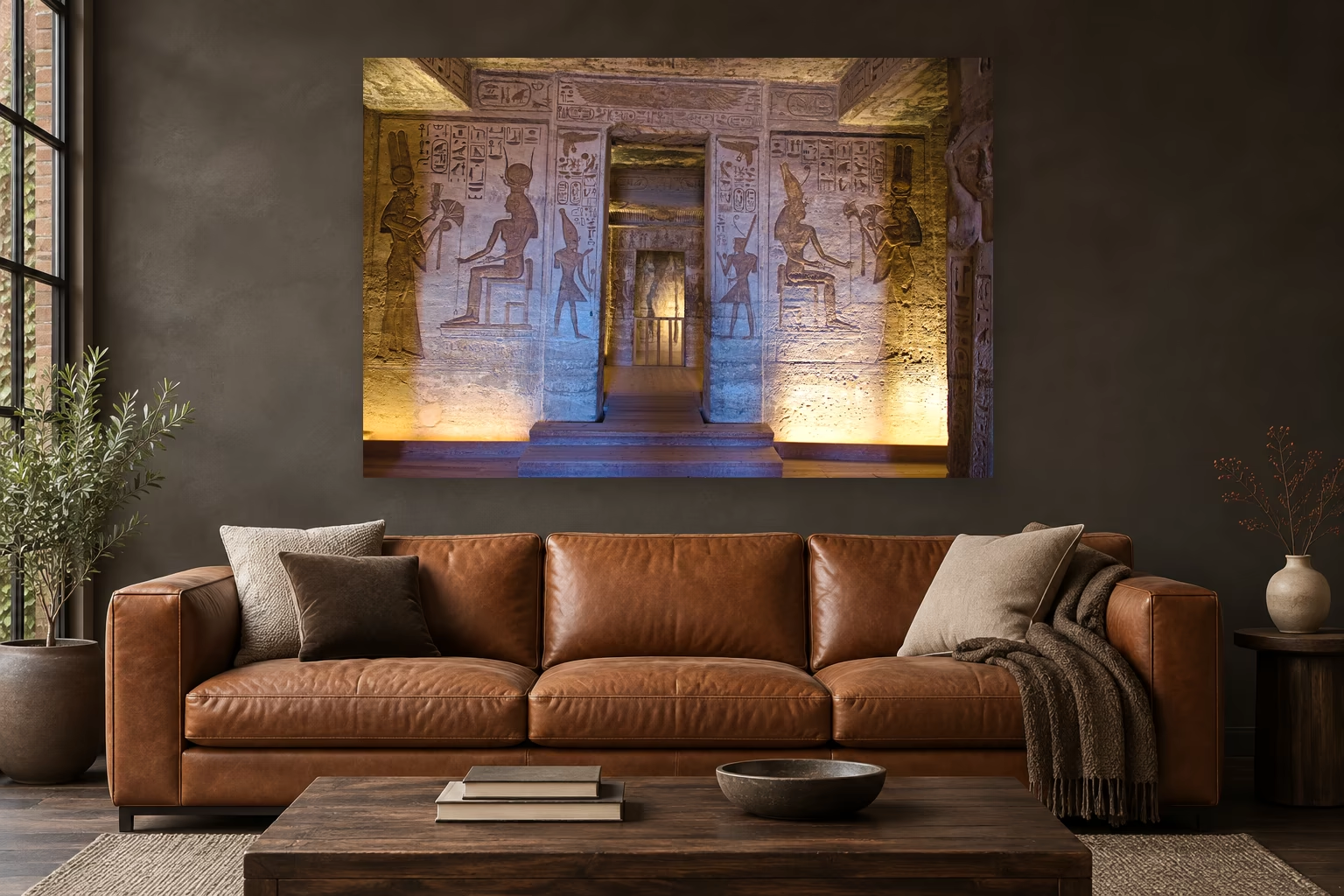
For print the symmetry carries the picture: the door in the middle, the walls to either side, the bright threshold below as a counterweight. Matt paper keeps the warm yellow and the cool grey apart and lets the doorway stay deep; on aluminium Dibond the edges grow harder and the threshold steps forward. At 60 × 40 cm the order stays calm, at 90 × 60 cm the signs can be read, and at 120 × 80 cm the door works like a passage in the wall. Direct light from the front takes the depth out of the relief; side light is better.
Material and finish
Fine art canvas
The motif is printed in 12-colour pigment printing on cotton canvas and stretched on a 2 cm solid wood frame.
The textile surface gives the picture a warm feel. A mirrored edge carries the motif sideways; the front remains complete.
- Support material
- Cotton canvas, 260 g/m²
- 12-colour pigment inkjet
- Frame
- Wood, 2 cm
- Edge
- Mirrored motif
- Sizes
- 60 × 40 cm90 × 60 cm120 × 80 cm
- Scope of delivery
- Printed cotton canvas on a 2 cm wood frame, hanging set included. Without an additional picture frame or shadow gap frame. Screws and wall plugs are not included.
Aluminium Dibond
3 mm aluminium composite panel with polyethylene core, printed in UV-LED direct printing: the ink sits directly on the white coated surface.
For wall mounting you need a suitable hanging system and a fixing that matches your wall.
- Support material
- 3 mm aluminium composite panel
- UV-LED direct print
- Surface
- Matt
- Finish
- Frameless, right to the edge
- Sizes
- 60 × 40 cm90 × 60 cm120 × 80 cm
- Scope of delivery
- Printed panel without hanging set or wall mounting material
Fine art paper
Hahnemühle Museum Etching is an artist paper made of 100 % cotton, natural white and without optical brighteners. It is printed in pigment inkjet.
The paper can be framed as you wish.
- Support material
- Hahnemühle Museum Etching
- Weight
- 350 g/m²
- Composition
- 100 % cotton, acid and lignin free
- Pigment inkjet
- Sizes
- 60 × 40 cm90 × 60 cm120 × 80 cm
- Scope of delivery
- Paper print without frame