
About the motif
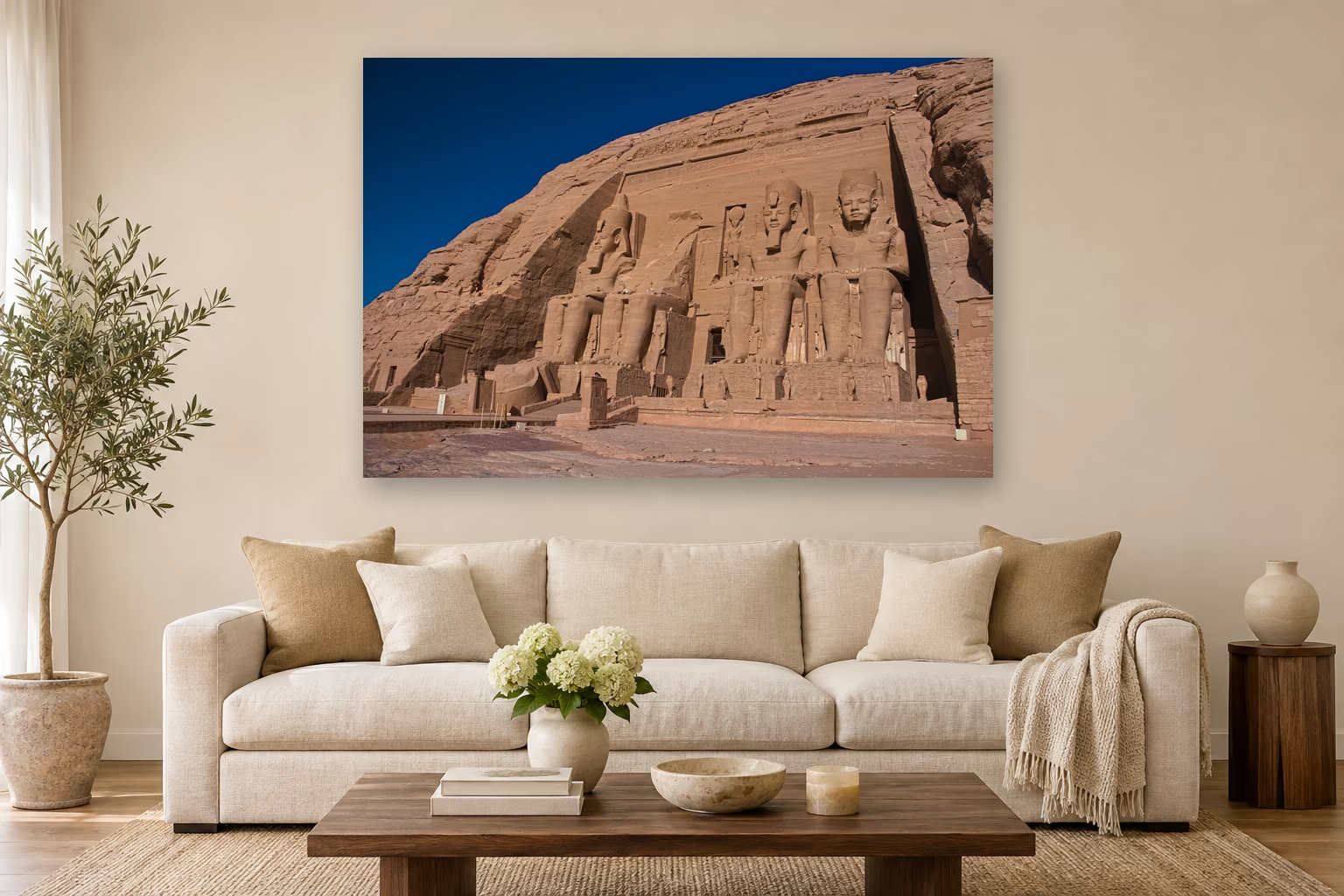
The sky is only a corner: a piece of blue at the upper left, elsewhere the rock closes the frame. In the centre stands the facade, four seated colossi side by side, the axis with the entrance a little right of centre. Above the statues run two bands of signs, above them the row of baboons raising their arms to the sun, and beyond that the rough rock begins. In front of the facade lies an uneven court, on the left a ramp leads up to a terrace, and on its edge stands a single person.
Of the four colossi the second from the left has lost its whole upper part: head, chest and arms are gone, only the throne, the legs and the base remain. The other three sit upright with headcloth, uraeus and royal beard, hands flat on their knees. At their legs and bases stand small figures, queen and princes, tiny in proportion. Between the statues run vertical columns of signs with the king's name rings, and above the entrance a niche opens with the falcon-headed sun god.
The light is hard and comes from the left, the shadows fall to the right and into the entrance, which stays almost black. The sandstone glows in warm red-brown, the shadows are cool, and the patch of sky at the upper left is so deep a blue that it reads as a surface. Fine cracks run across the figures, the stone is washed out at the edges, and dark traces of water and dust sit on the bases. At a five-hundredth of a second and f/8 everything is sharp, and the grain of the stone remains as texture.
Ramses II had the temple cut into the cliff above the Nile around 1260 BC, at the southern border of his realm. Whoever came up from Nubia saw these four figures of him first, each about twenty metres high, and above them the signs that carried his name. The second colossus broke in an earthquake in antiquity, and its fragments stayed lying at the foot of the facade. In the nineteen sixties the whole site was taken apart and rebuilt sixty metres higher so that the reservoir would not reach it.
For print the picture is a contrast: warm red-brown against deep blue, with the black doorway between them. Matt paper keeps both calm and lets the blue stay deep, aluminium Dibond makes the contrast harder, which suits the hard morning light. At 60 × 40 cm the bands of signs can still be read, at 90 × 60 cm the colossi step into the room, and at 120 × 80 cm the facade acts like a window into the rock. Side light suits it; direct light from the front takes the depth out of the sandstone.
Material and finish
Fine art canvas
The motif is printed in 12-colour pigment printing on cotton canvas and stretched on a 2 cm solid wood frame.
The textile surface gives the picture a warm feel. A mirrored edge carries the motif sideways; the front remains complete.
- Support material
- Cotton canvas, 260 g/m²
- 12-colour pigment inkjet
- Frame
- Wood, 2 cm
- Edge
- Mirrored motif
- Sizes
- 60 × 40 cm90 × 60 cm120 × 80 cm
- Scope of delivery
- Printed cotton canvas on a 2 cm wood frame, hanging set included. Without an additional picture frame or shadow gap frame. Screws and wall plugs are not included.
Aluminium Dibond
3 mm aluminium composite panel with polyethylene core, printed in UV-LED direct printing: the ink sits directly on the white coated surface.
For wall mounting you need a suitable hanging system and a fixing that matches your wall.
- Support material
- 3 mm aluminium composite panel
- UV-LED direct print
- Surface
- Matt
- Finish
- Frameless, right to the edge
- Sizes
- 60 × 40 cm90 × 60 cm120 × 80 cm
- Scope of delivery
- Printed panel without hanging set or wall mounting material
Fine art paper
Hahnemühle Museum Etching is an artist paper made of 100 % cotton, natural white and without optical brighteners. It is printed in pigment inkjet.
The paper can be framed as you wish.
- Support material
- Hahnemühle Museum Etching
- Weight
- 350 g/m²
- Composition
- 100 % cotton, acid and lignin free
- Pigment inkjet
- Sizes
- 60 × 40 cm90 × 60 cm120 × 80 cm
- Scope of delivery
- Paper print without frame