
About the motif
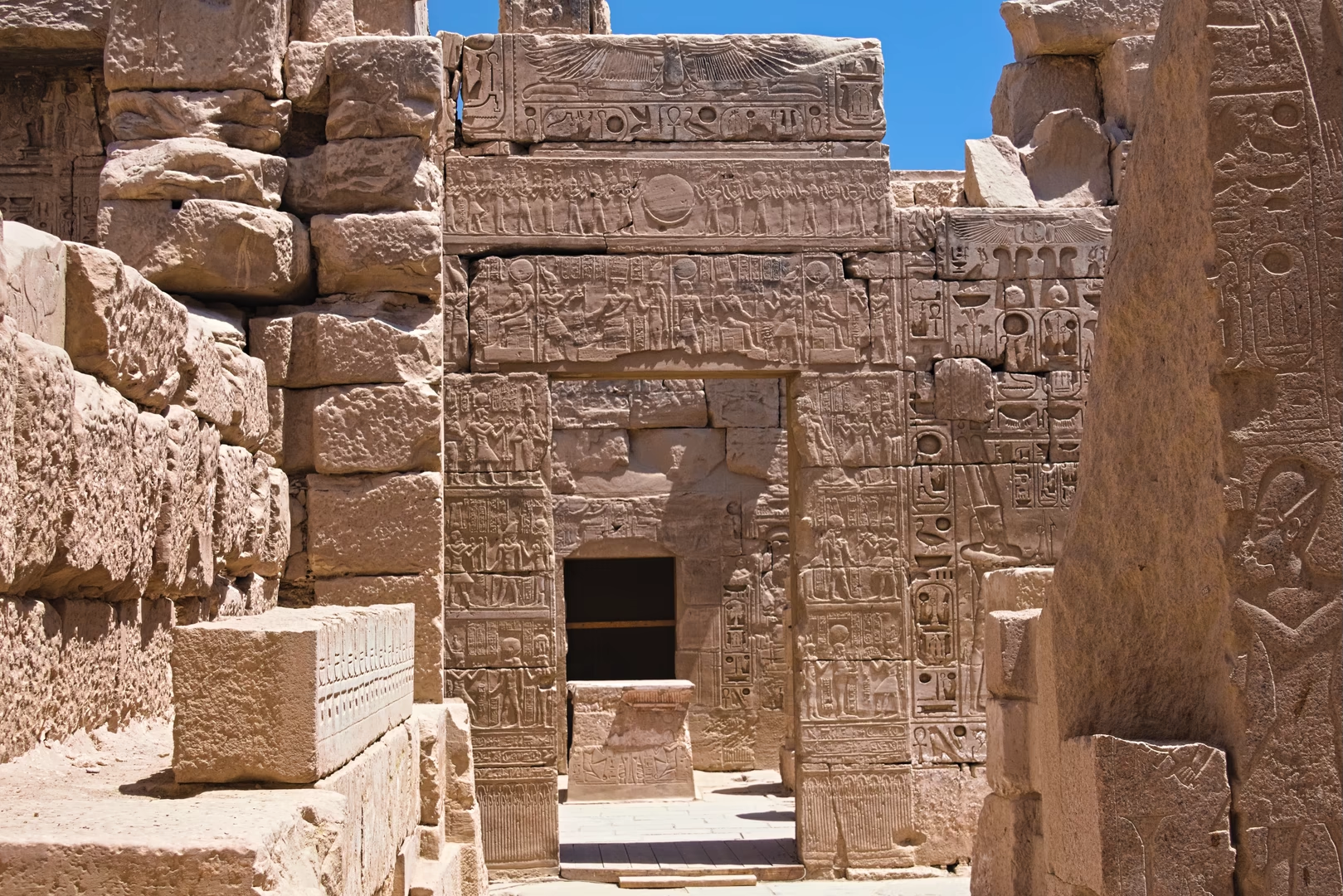
The passage sits in the centre, two door jambs of large blocks frame it, and above them a lintel closes the opening. A winged sun disk is carved into the lintel, its wings running out to both sides. The jambs carry vertical columns of hieroglyphs, and beneath the lintel cartouches and figures stand in registers. To the right of the opening the wall is densely covered with reliefs, to the left the blocks are larger and bare. Inside the passage stands a worked block, and behind it a second, darker corridor opens. In the left foreground lies a stone with an inscription band running around it, on the right a cut-off architectural element reaches into the frame, and the floor is made of slabs. Above the gate stands a cloudless blue sky.
A gate like this was not merely a way through. Whoever entered the precinct passed a frame of stone that carried the same message on jambs and lintel: the winged disk as protection above the entrance, beneath it the names of the ruler who had built. In the great complexes of Upper Egypt gates, pylons and courts line up one after another, each with its own inscription, so that the way through the temple was at the same time a way through reigns. The narrow opening in the photograph belonged to a side room, not to the main axis.
The sandstone is soft enough to take writing and hard enough to stand in the open for centuries. The reliefs are sunk, the outlines cut in as a groove, the inner surfaces levelled. Joints between the blocks, broken edges and spalled faces show how much the bond has suffered; individual blocks are missing entirely. The slab floor is polished smooth where feet pass.
In the photograph bright daylight stands against a dark interior. The midday sun lies on the lintel and the jambs, the corridor behind stays almost black, and that jump creates the depth. Whoever walks through sees nothing for a moment and only then finds the outlines of the next room. That transition is the subject: not the building alone, but the moment of entering.
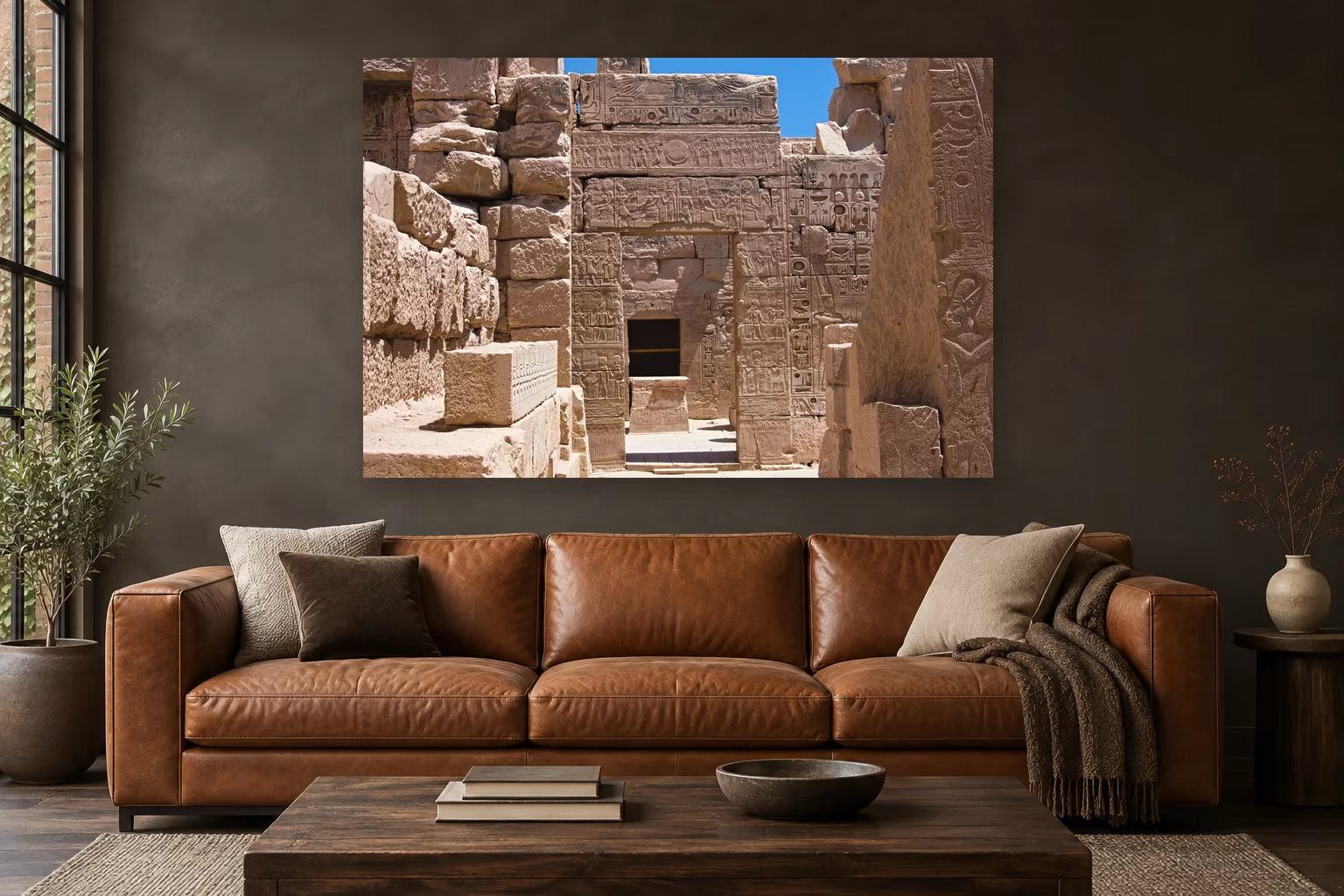
As a wall piece the photograph works with this contrast. The bright surfaces carry the writing, the dark rectangle in the middle gives the room an anchor. In large formats the carving stays legible, in smaller ones the image reads as a closed surface of sandstone and shadow. This fine art print is particularly suited to hallways and studies, to stairwells and to living rooms with warm wood tones, where a dark accent sits well.
Material and finish
Fine art canvas
The motif is printed in 12-colour pigment printing on cotton canvas and stretched on a 2 cm solid wood frame.
The textile surface gives the picture a warm feel. A mirrored edge carries the motif sideways; the front remains complete.
- Support material
- Cotton canvas, 260 g/m²
- 12-colour pigment inkjet
- Frame
- Wood, 2 cm
- Edge
- Mirrored motif
- Sizes
- 60 × 40 cm90 × 60 cm120 × 80 cm
- Scope of delivery
- Printed cotton canvas on a 2 cm wood frame, hanging set included. Without an additional picture frame or shadow gap frame. Screws and wall plugs are not included.
Aluminium Dibond
3 mm aluminium composite panel with polyethylene core, printed in UV-LED direct printing: the ink sits directly on the white coated surface.
For wall mounting you need a suitable hanging system and a fixing that matches your wall.
- Support material
- 3 mm aluminium composite panel
- UV-LED direct print
- Surface
- Matt
- Finish
- Frameless, right to the edge
- Sizes
- 60 × 40 cm90 × 60 cm120 × 80 cm
- Scope of delivery
- Printed panel without hanging set or wall mounting material
Fine art paper
Hahnemühle Museum Etching is an artist paper made of 100 % cotton, natural white and without optical brighteners. It is printed in pigment inkjet.
The paper can be framed as you wish.
- Support material
- Hahnemühle Museum Etching
- Weight
- 350 g/m²
- Composition
- 100 % cotton, acid and lignin free
- Pigment inkjet
- Sizes
- 60 × 40 cm90 × 60 cm120 × 80 cm
- Scope of delivery
- Paper print without frame